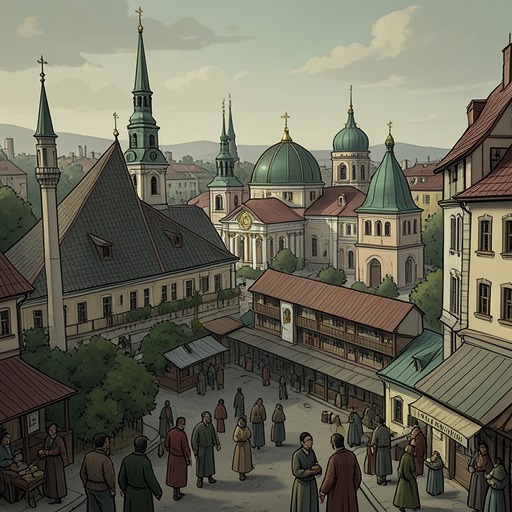
Stanislawiv Armenian Cathedral
Felix AustriaThe Armenian Cathedral of Stanislaviv is a place of worship and a site of close inquiry into reported miracles. Josef repeatedly walks its cold floor and studies the records associated with its miraculous icon of the Virgin of Tenderness. The cathedral’s devotional history gives the novel a concrete setting in which religious testimony and emerging explanations of healing meet; beyond this local focus, it belongs to a city whose varied religious communities are shaken by the disappearance of sacred objects.
Setting and sacred image
The cathedral was built on the order of Józef Potocki with money from the Jewish community. Its history therefore carries the city’s religious plurality into the fabric of the building itself. The novel does not treat it only as an architectural landmark: it is an active devotional space, walked by Josef almost daily as he considers the relationship between faith and healing.
At the center of his attention is the icon known as the Virgin of Tenderness of Stanislaviv. Josef consults a detailed register listing dates and the names of people said to have received the Virgin’s grace or witnessed a miracle. Its entries preserve individual claims rather than an abstract account of belief: one recounts the recovery of Marianna Yakoubovytch, who prayed before the icon in 1742 after years of suffering; another records the Jesuit priest Mykola Sacher’s report that prayer relieved a severe headache. The register makes the cathedral’s reputation legible through accumulated testimony.
Josef’s inquiry into miracles
Josef approaches religious healing with an interest in hypnosis and its possible mechanisms. He is intrigued by Charcot’s perceived parallels between hypnosis and faith, and reasons that the mysterious healings attributed to saints may operate by a mechanism similar to hypnotic treatment. His attention to the icon and its register thus joins reverence for reported miracles with a search for an explanation grounded in contemporary medical ideas.
The register includes a further account from November: Father Manouguevytch said that he saw the icon surrounded by blue clouds throughout a funeral service, and Brother Dominique Donikevytch confirmed the report. The testimony does not settle whether the event should be understood as supernatural or through Josef’s developing interest in faith and hypnosis. Instead, the cathedral becomes a setting where reported experience, communal witness, and rational speculation remain in contact without being reconciled.
A city of contested sacred objects
The cathedral’s focus on a miraculous image forms part of a wider religious landscape unsettled by thefts. Reports describe sacred objects vanishing from Christian churches and Jewish synagogues, sometimes from locked and apparently undisturbed rooms. A rabbi in Tchortkiv reports the disappearance of a silver container used to hold the etrog; the missing objects from Brody’s synagogue include a kiddush cup, a Hanukkah lamp, and a yad. The range of objects and communities makes the thefts a shared civic crisis, even as each item belongs to a particular ritual practice.
Josef and Petro discuss the growing number of disappearances in the Anger household. Petro proposes that religious servants themselves might be responsible, while Josef points to the coincidence between the thefts and performances by Ernest Thorn, a magician and swindler. The cathedral is not identified as a theft scene in these passages; rather, its documented miracles provide a counterpoint to the unexplained losses elsewhere. Across the city, the same question presses on both kinds of account: what can be believed when an event appears to exceed ordinary explanation?
Narrative significance
The cathedral’s register gives religious memory a specific form: names, dates, illnesses, prayers, witnesses, and reported outcomes. That documentary texture contrasts with the uncertainty surrounding the missing relics, whose disappearance invites competing accounts ranging from human theft to supernatural transport. By placing Josef’s investigation of healing within a building shaped by Stanislaviv’s multi-faith history, the novel presents religious belief neither as mere superstition nor as a matter resolved by scientific curiosity.
The distinction between Christian and Jewish sacred objects remains meaningful even as the thefts cross communal boundaries. Near the novel’s catastrophic ending, the stolen objects appear together around the fallen stone woman amid the fire: Christian vessels and relics are named beside the silver etrog container and the synagogue’s ritual objects. Their convergence turns the scattered reports into a material revelation, while the cathedral’s earlier record of miracles has already established how objects, testimony, and belief can shape the city’s understanding of what is possible.